The bulk of the work that I do as a teacher often focuses around one thing. Though grading is certainly a big component, there is an area that takes up even a little more, and that is the writing of my curriculum. I spend my early mornings at the school working on this craft, planning out my next unit, taking careful consideration for each piece. The incredible teacher that I student taught under always had the same mantra- if his name was on it, people could guarantee that his best effort was going to be put into it. The same went for his lesson plans, and it was an approach that he instilled in me.
Clearly, a major component of teacher writing revolves around the creation of the course materials that students will see, specifically with the lesson or unit plans that we create. We focus on learning this skill as teachers-in-training. Teachers want to build the best materials they can because we want to create the best learning opportunities possible for students.
As it is a critical part of education, we need to have a more in-depth discussion of the implications of lesson plan writing. This includes how it is situated as a genre, and not the conception of genre that is merely about textual features, but about the rhetorical components of their creation and how we should approach them. To do this, I will be presenting a specific genre of lesson planning known as Understanding by Design (UBD) to show how important it is to understand the implications of written communication like genre in order to approach these UBD unit plans successfully.
Explanation of Genre
Genre has long been considered simply as a form of classification, a way that we can identify certain texts as being a specific kind. However, Amy Devitt (1993) presents a conception of genre that is much more thought-provoking for teachers. She sees genre as a rhetorical concept. Certainly text features are still important, however, she sees that these features are simply a response to the writing that has become before them. Writers are able to recognize when writing situations, or rhetorical situations, are continually repeated and require the same type of written response, this makes the writing process more effective, as we must present the right subject matter within a genre in order for it to be useful. This is connected to Lloyd Bitzer’s view of the rhetorical situation that focuses on exigence, or the reason for writing; the audience, or who we are targeting; and constraints, or the outside influences that can impact the effectiveness of the text. However, Devitt (1993) also extends the view of rhetorical situation to also include understanding of the social and cultural context that our language is fulfilling. She shows that genre is a way to make meaning in given situations. Furthermore, it also helps us to construct situations at the same time, as the readers of the text will create understandings or ways of viewing those texts, which is what can be seen as a situation. The same is true for pedagogical genre such as the unit plan. Thus, when creating any text, we must understand the context behind it as we craft them if we want our subject matter to be truly effective.
There are other important considerations for genre that are brought forward by author Charles Bazerman (2002), who sees that participation in various genres helps to shape our identities. Furthermore, as people learn how to partake in these genres, they are also able to begin to shape the genre and meet their needs or desires within that genre. He states that “As participants orient towards this communicative social space they take on the mood, attitude, and actional possibilities of that place-they go that place to do the kinds of things you do there, think the kinds of thoughts you think there, feel the kind of way you feel there, satisfy what you can satisfy there, be the kind of person you can become there” (Bazerman, 2002, 13). This also occurs in the genres that teachers participate in. Their identities as professionals can be shaped through the genres they are a part of, however, they can also create change by understanding those genres (Bazerman, 2002). Thus, not only must teachers understand the context behind genre, but they must also understand how genre shapes them.
Stephen Neaderhiser (2016) shows and builds on the importance of genre for educators in his article “Hidden in Plain Sight: Occlusion in Pedagogical Genres.” He argues that there are certain genres within teacher identities that are hidden or occluded from the public eye. This includes the creation lesson plans or other materials a teacher creates. They may not be considered hidden genres, as they are still seen by students, but rather what is hidden is the other roles that this genre may play in different contexts, as it is rhetorical. If this is not understood, it can have major implications, as “Not only can this occlusion impair teachers from meeting the expectations of those hidden readers, but it also can negatively impact the classroom… Without a critical discussion of how a genre operates, the genre appears to be straightforward and “obvious” in its construction” when it may not be (Neadherhiser, 2016, no page number). He offers the examples of the syllabus as a meta-genre, which at first glance may be only met as a “contract” between the teacher and student, however, it may also serve as a means of accountability for the institution in which the teacher is working. He argues “The rhetorical nature of the syllabus as a pedagogical genre with multiple purposes (and accompanying tensions) is occluded behind a façade of functional oversimplification” (Neaderhiser, 2016, no page number). The implications if we let this happen in other genres is clear, including Understanding By Design as lesson planning.
Explanation of UBD Work
Lesson planning is clearly its own type of genre that must be understood. Thus, I would like to discuss a specific kind of lesson planning genre and what it can show us about learning about this piece of written communication. Understanding by Design (UBD) is a part of my district’s work on teacher clarity, something you can learn more about through this post. UBD has the goal of having a “standard-driven curriculum to help teachers clarify learning goals, devise revealing assessments of student understanding, and craft effective and engaging learning activities” (Authentic Education, 2015). Teachers design unit plans, starting at stage 1, which requires working backwards from the standards they are covering, followed by creating the major understandings students will have that can help them navigate the real world and the essential questions that will be answered. Stage 1 of the learning process is finished by determining what students be able to do (skills), what they will be able to understand by the end of the unit (the essential knowledge).
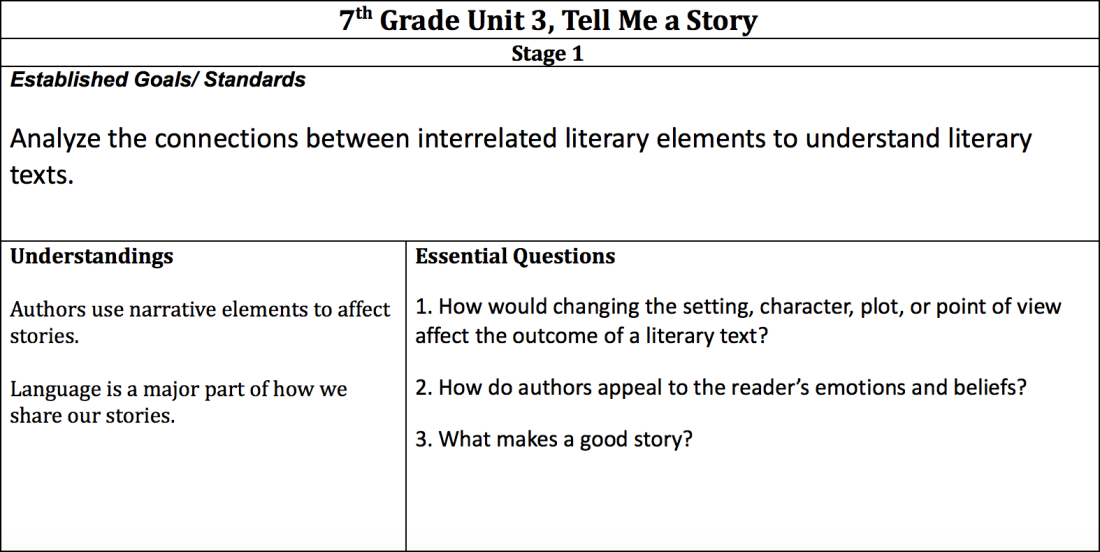
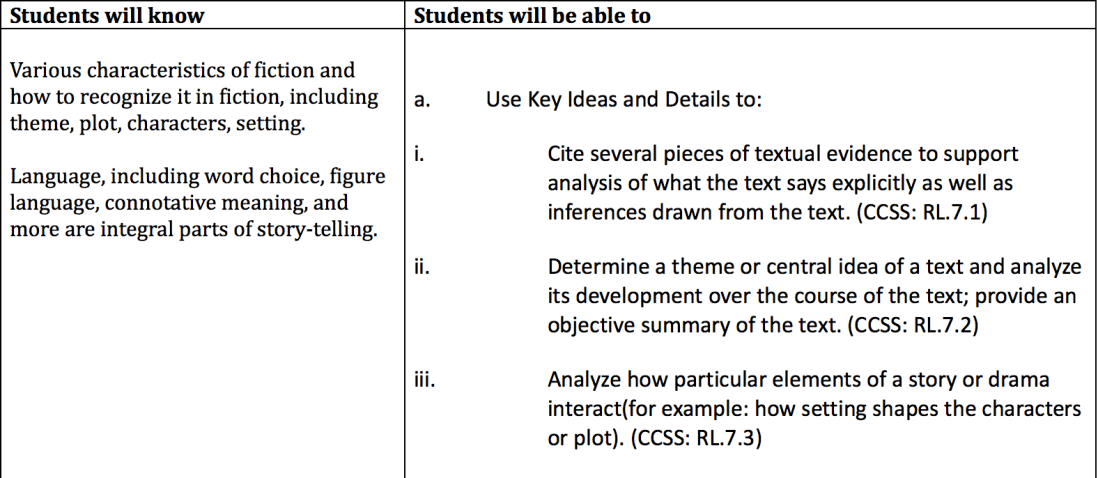
Photos: A sample of an Understanding by Design template used in 7th Grade English.
The second stage of the unit plan looks at performance tasks, or what major assignments will be used to assess student learning of the topics brought forward in step 1, as well other modes of formative assessment. Finally, stage three presents the progression of the learning plan.
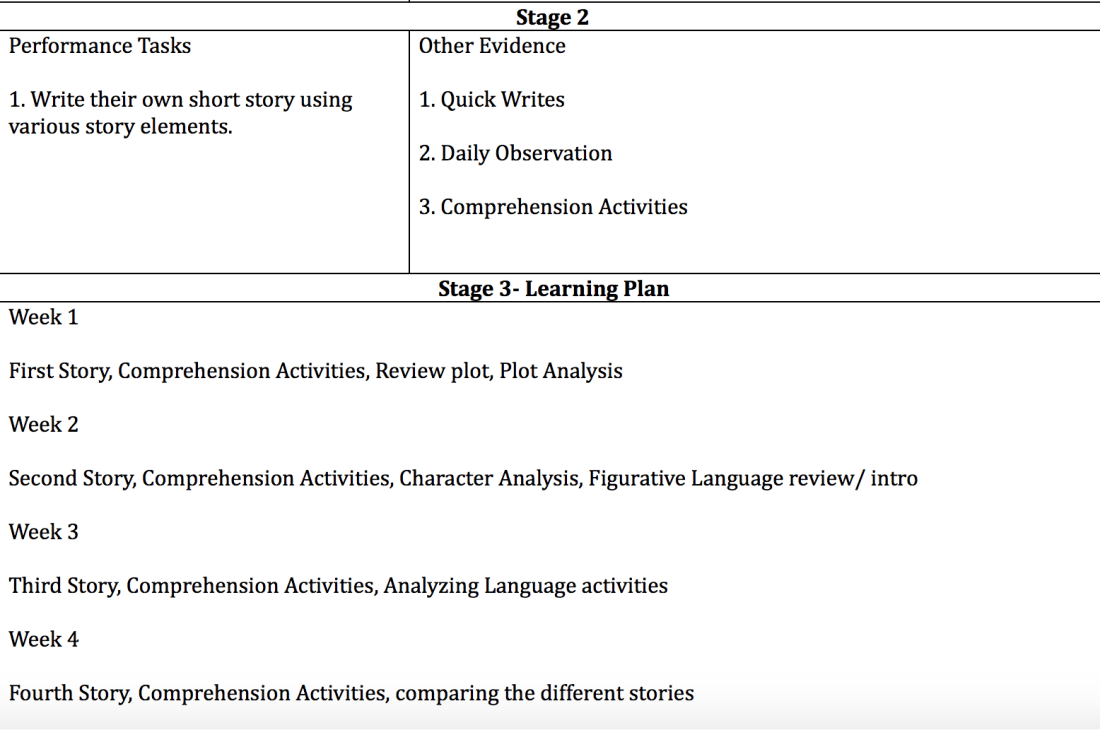
Photo: A sample of stage 2 and 3 from the same unit in 7th Grade.
The UBD Planner as a Genre and the Implications
As a genre, the UBD planner certainly has shaped my identity as an educator. It has shown me the importance of designing a curriculum that is clearly aligned with standards. It has made me better at being able to clearly assess learning. It has allowed me to make changes that better my classroom as I participate as a part of the genre. I am able to construct new situations of student learning.
Furthermore, just as a syllabus may play multiple roles, so may the UBD planner. It certainly falls under the roll of an occluded genre, and is very rhetorical in nature. It might be seen as something that only students see, but it is about much more than that. For my administration, the UBD planner is a means of accountability, a way for me to show that I am working towards the goals of the district. For my students, the planner represents what they are expected to learn. If we do not understand these two different purposes of the genre of unit plan writing, it can limit our effectiveness. I have to meet the expectations that have been set forward by administration (ones that have been specifically designed to help us become more effective). I must also ensure that components that students will see are in student friendly. For our regional educational unit, it is a means of creating improvement across the region. I must understand these nuances within this genre if I am going to adequately meet the different needs of these various rhetorical situations.
This is only one type of genre, and only a few of the implications. What genres do you participate in as an educator? How can analyzing them provide better understandings for yourself and your classroom?
Reference List
Authentic Education. (2015). “What is Understanding By Design?” Retrieved from https://www.authenticeducation.org/ubd/ubd.lasso.
Bazerman, C. (2002). “Genre and Identity: Citizenship in the Age of the Internet and the Age of Global Capitalism.” In R.. Coe, L. Lingard, and T. Tenslenko (Eds.), The Rhetoric and Ideology of Genre: Strategies for Stability and Change (13-37). Cresskill, New Jersey : Hampton Press, Inc.
Devitt, A. (1993). “Generalizing about Genre: New Conceptions of an Old Concept.”Composition and Communication, 44 (4), 573-586.
Neaderhiser, S. E. (2016)““Hidden in Plain Sight: Occlusion in Pedagogical Genres.” Composition Forum, 33.


Hi Keeya,
I really enjoyed reading your blog post this week. You showed your expertise about the subject clearly, which allows readers to trust you as a credible source. I appreciate how, instead of just jumping into your main points, you clearly defined genre and what it means in the classroom– to both the students and teachers.
Your Understanding by Design is a great way to develop genre with established goals in order for students to both comprehend genre and create genre on their own. In addition, I really liked how you use a table to organize and simplify UBD for your readers. For me, graphs and tables make it easier to understand and fully comprehend text.
Your blog was well thought out and organized. The only thing I would suggest is adding a few small pictures here and there to give the text a little bit of color and something else to break up the text a little more.
Awesome work!
Jessilyn
LikeLike
Hi Keeya,
Very informative and well-organized! I enjoyed how you were able to apply your work as an educator directly to the assignment, which illustrates your expertise in this particular genre. You cover the definition of genre, discuss rhetorical situations, identity, and the growth/adaptation of all of these rather effectively and eloquently. I also like how at the end, you address the audience directly and ask them to consider genre in their own teaching experiences. The use of visual aids was also informative. Your Neadherhiser source is solid and supports your points. Here are just a couple very specific suggestions: In the “Explanation of Genre” section, remind us again what “Lloyd Bitzer’s view of the rhetorical situation” is. In the same paragraph, can you clarify “construct situations at the same time?” Also, it looks like you are using APA format. If there is no page number, is there a subheader from the source and a paragraph number you can use instead? Also, a few colorful images would add some flair. Great work!
LikeLike
Keeya,
Lesson planning is such a relevant genre, especially for me (I teach ENG right now, so it’s a part of my daily life). The UBD planner is very interesting. I’ve seen lesson plans formatted like this before many times, but personally have not used this format myself. However, I can see why it would be incredibly beneficial for connecting lessons to classroom goals and learning outcomes. Right now, I typically have a list of the daily activities we do in class along with time estimates for each item (so I stay on track). Then I have the homework and attendance question written down too. The UBD lesson plan is much more in depth than my own–I think mine works for me because I keep it chronological so that I don’t lose track of time. However, after seeing a sample UBD (very helpful by the way), I think mixing the two types of lesson plans may be perfect for me. I like when you mentioned “the UBD planner is a means of accountability, a way for me to show that I am working towards the goals of the district.” This is important for me as well, to show that I meet the course learning outcomes for ENG 105 and 205. I just hadn’t been formatting my lesson plans this way. But like I said, this is a format I may need to consider so that my lesson plans become even more relevant and accountable. Thanks for sharing!
LikeLike
Hi Keeya!
I really like your introduction. It captures the reader’s attention and shares your subject in a succinct and easy to understand manner. I liked that you began this post with an inspirational anecdote about your personal conviction about your writing and the mentor who helped you develop it. You synthesize Devitt’s concepts about genre and its use as a rhetorical function within the context of your specific writing, and this helps to tie in your personal experience with the subject material. I thought that the paragraph that incorporated Bazerman’s text was a bit awkwardly worded—his name and (2002) were written more often than I think was necessary, and his quote might have been incorporated more smoothly into the overall flow of the paragraph, as you did in your next paragraph that cited Neaderhiser. I liked that you included thought-provoking questions for the reader at the end of your post. They were appropriate for the material presented and worked well as a conclusion. Overall, this was a great post!
LikeLike
Hi, Keeya,
I liked your description of UBD lesson planning. It was something I was not familiar with. You also do a good job defining genre. It wasn’t clear to me how UBD planning tied specifically into the ideas you discuss in your section about genre. I think combining the readings with UBD will provide more clarity. The first section is a good place to start with separate ideas and then show how they are going to specifically connect in a final sentence or thesis. Maybe two specific ideas about how genre relates to UBD rather than a section on genre and a section on UBD. It was an interesting read full of new ideas. Thank you for sharing!
LikeLike