
Globalization is now a major part of our world, and perspectives of the people and cultures in different areas of the globe are so important to understand. We can no longer act as though the actions we make here have no effects elsewhere. Teaching this is by no means an easy task. Even for my students who are invested in school, they may at times struggle to understand why perspectives outside of their immediate world is important. For those who already struggle in school, outside perspectives can be even more difficult.
I’ve often spent a great deal of my time thinking about the unique perspectives that my students bring into the classroom. Some grew up as a part of the all ‘American dream’- two parents who loved them deeply and pushed them to succeed, a couple siblings, a childhood where they were allowed to just be a kid in a small town. However, many kids didn’t get to live like this. Some students experienced their parent’s divorce. Some grew up in a single-parent household their entire life. A handful of my students grew up being the only one that spoke English in their household. One student just learned to speak English a little over a year ago. Some have spent their summers working in fields to help pay the bills. Some have spent their summers working in the fields because farming is a part of their family’s life (and they wouldn’t have it any other way). Many have unfortunately moved from place to place. I have worked very hard to make sure that I take their various perspectives into consideration. For many students, school is just not the most important thing, they have much bigger issues at hand. That does not mean that I do not challenge them, or try to get them invested in what they’re learning about, but I also have to recognize that sometimes they are simply not going to be engaged in what they are learning about. I try to offer student choice as much as possible to help mitigate these issues. Thus, unique perspectives are already a part of what I do. However, I have not spent a great deal of time teaching about other perspectives from other areas of the globe.
We can’t ignore globalization, it is a reality for all of us. Nor does preaching to students about its importance really work to get them invested. Rather, the written communication we use as teachers offers the ability to at least introduce students to outside perspectives that can allow them to have a greater appreciation of them. We’ve discussed Lesson Planning as a portion of the public writing in education on this post. The way we create our lessons plan, or ultimately we teach our students, has the ability to prepare them for a globalized world. This is just another way we can make positive changes for our students by becoming an ‘innovator’ for teaching globalization.
Perspectives on Globalization
Suzan Canli and Hasan Demirtas (2018) define globalization as “an international, intercultural, economic, political, cultural and social integration… where distant settlements were interrelated and local events are shaped by distant events” (80). These authors argue the rise of globalization has created a shift in education where students must be taught the skills that will make them better equipped to participate in an interconnected world where their actions can have effects elsewhere. These authors argued “today’s educational programs should be organized to train individuals so that they could acquire experiences in globalization that could be influenced by international and intercultural interactions. It should also assist the individual to understand that she or he is an inseparable part of the world in which she or he lives in” (Canli and Demirtas, 2018, 81).

Though these authors conducted a study in Turkey to determine Turkey’s teachers perceptions of this shift and where there might be issues in applying them, the findings that these authors finish their article with provides understandings that are valuable for all teachers embarking on the journey of teaching globalization (Canli and Demirtas, 2018, 81). The most important is that teachers have the capability to be innovators when it comes to teaching globalization if they are open to the change that is needed. First, they must become global teachers, or a teacher that “is competent in technology and information technologies, possesses universal educational-instructional qualities, is open to differences, is a global citizen, thinks universally, adapts to universal values, possesses the values of her or his own culture with an active and participatory learning approach, shares knowledge, is objective and a model for the society” (Canli and Demirtas, 2018, 85). It also includes introducing students to multicultural views, without necessarily ignoring their own. The authors present other findings on the changes that teachers need to make, however, the most important is that it requires teachers to assess themselves and work towards their own improvement in these various areas. All teachers have the capability to be innovators when it comes to teaching globalization, we must just think about our practices and how we can improve upon them (Canli and Demirtas, 2018).
So How Do We Teach It?
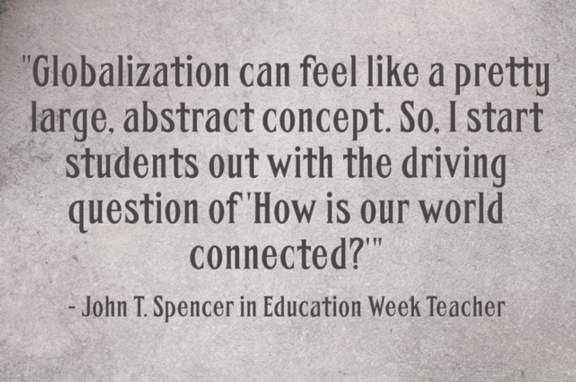
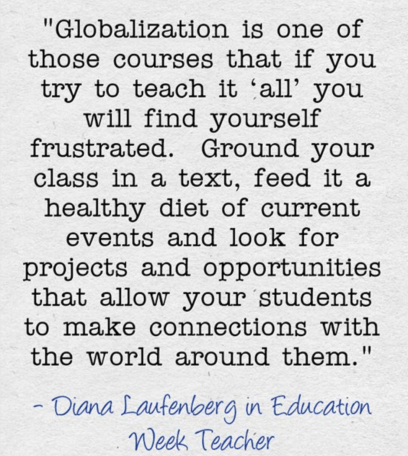
There have been many teachers that have come before in approaching teaching globalization. Larry Ferlazzo (2014), a writer for Education Week, shared a variety of interviews with teachers that were teaching about globalization. Even though it is a ‘large, abstract concept” or one that “if you try to teach it ‘all’ you will find yourself frustrated,” these teachers approached it successfully. They offered many ideas, from connecting students to current events from around the world, looking at how one product is connected to multiple parts of the globe, and, most importantly, recognizing that we cannot teach every piece of globalization, but can at least begin to show students how interconnected the world is. This was in 2014. There are so many more ways we can approach this now (Ferlazzo, 2014).
With the rise of globalization, there has also been a rise in the importance of social media. The connections to teaching globalization are clear, such as Canli and Demirtas (2018) stated about the importance of media to a global teacher and the need for technological competence. IDS (2013) stated that a quarter of the entire world’s population uses social media. Our students understand social media, they relate to it. It is what engages them. Social media might be an excellent place to teach about globalization. As stated by Christopher Swan (2012), social media has the ability to break down barriers (whether those be power related, social, or cultural) and create global conversations about issues that face our world today. It gives everyone a chance to become involved. I believe we can get students involved in global conversations by connecting the teaching of globalization to social media within the lesson plans that we write. It is where we can provide our own forms of innovation.
Perhaps it is crafting assignments where students create Twitter accounts through researching and sharing findings on the experiences of people in other parts of the world (much like Global Classrooms DC that shares a variety of stories from across the globe as a way to help students become more globally aware, you can check out their Twitter here). Perhaps it is assignments where students research a major issue in another country and present their findings through a Facebook, Twitter, or Youtube page. Maybe we ask students to relate how these experiences connect to their own lives. There are so many options, we just have to find them. I do not believe it will be a quick process. It does not have to be done all at once. However, any little bit we can ‘innovate’ can be helpful.
Ultimately, the true goal of teaching globalization is to “help students learn about the differences among people in the multicultural world and the significant global problems they face” (Canali and Demirtas, 2018, 90). This will make them better prepared for the world they will face as members of our society. Individual teachers have the power to be innovative within their classroom by analyzing how they approach global conversations. Entire schools have the ability to innovate to have more inclusive views. This does not mean that we forget our own culture, but rather give our students a much wider perspective.
I will leave you with a question. What can you do? If you are already teaching about globalization, what practices do you use that you find especially successful?
Now, if you will excuse me, it is time to go innovate.
Reference List
Canli, S. and Demirtas, H. (2018). “The Impact of Globalization on Teaching Profession: The Global Teacher.” Journal of Education and Training Studies, 6 (1), 80-95.
Swan, C. (2012). “Connecting the World Through Social Media.” International Association of Business Communicators. Retrieved from https://www.iabc.com/connecting-the-world-through-social-media/.
Institute of Development Studies. (2013). “IDS: A Year in Social Media.” Retrieved from https://www.youtube.com/watch?v=n0ezsCbVKUY.
Ferlazzo, L. (2014). “Response: Ways to Teach Globalization.” Education Week Teacher. Retrieved from https://blogs.edweek.org/teachers/classroom_qa_with_larry_ferlazzo/2014/06/response_ways_to_teach_globalization.html.

 Educators as Writing Professionals
Hi Keeya,
You did a nice job of articulating to your audience of teachers how to approach the topic of globalization in the classroom. Your images worked well to emphasize your content points, and I thought you chose relevant and substantive sources to support your argument. The only suggestion that I have for your blog is consider using (if you can find one) an example of an actual lesson plan(s) that a teacher used and thought was successful. Spelling out a plan and allowing readers to actually an approach in action, of sorts, would really help support your argument. I understand that this may not be all that easy to find though.
Great post!
~Linda
LikeLike
Keeya,
Wow! Those graphics really enhanced this piece. I liked seeing the excerpted quotes from Education Week stand out.
It was so interesting to see the final section begin with a question. I wonder about expanding on that question with a series of followup questions that might drive future discussions. I can see that you have introduced a topic, but like Linda said, the next step is real examples. An alternative to a lesson plan might be followup questions.
Bryn
LikeLike
Keeya,
I really like your style and voice. It makes your blog easy to follow and enjoyable to read. You do an excellent job blending all of your sources with your own ideas to make it flow. It creates ethos for your audience. I think it would have been nice if you could have included your specific teaching experience throughout the entire post. I was really curious how you were planning on implementing your ideas about social media and globalization to a classroom that doesn’t seem to have much interest in either. I’m sorry this class is ending, so I won’t get to see your conclusions. Nice post!
LikeLike
Hi Keeya,
You’ve done a really great job this week of connecting the message of globalization to your work in the classroom. It is very insightful and informative, and your personal experiences help drive the message of how important it is to teach globalization to the next generation. Your sources are nicely incorporated into your narrative, and it is clear that you are a person who knows what she is talking about from first-hand experience, which naturally engages audiences and makes them want to listen. You let us know right away who you are, and you have effectively managed to incorporate each week’s themes into your education genre and your work as an educator, which provides continuity between all of your blogs and adds to your credibility as a subject matter expert. Your “so how do we teach it” section is especially strong and I love the educational exercises you have proposed in order to engage your students. I also like how at the end you put it back into the hands of the audience by asking “What can you do?” You get a sense of your dedication to your work which flows through the thoughtfulness of your paragraphs.
I have two suggestions for you. The first is because your blog is in a narrative form that is more like an essay, you may consider adding a couple more images to break up the paragraphs. Second, your first paragraph, although it sets the stage is a bit long without announcing what the discussion is going to be right away. The audience might not know where this is going. To remedy this, you might consider beginning with the shorter, second paragraph so the blog begins with, “With globalization now a major part…” I think it would nicely fit at the beginning. Other than that, excellent job!
LikeLike
Hi Keeya!
Globalization and global communication can be difficult subjects to find pictures for and I think you did an excellent job here! I like that you started your blog with an example of how having students from different backgrounds shaped your perspective of this topic. You set the exigence perfectly and encourage the reader to become interested in the topic. I like that you linked back to another blog and that you link this subject to your work. Your subjects throughout the post help the reader to understand the next part and I particularly liked you use of “So How Do We Teach It?”. I thought it was a good way to incorporate the perspectives on globalization into practical application. I do think you could use one more subject break before your conclusion, perhaps something like “Now Let’s Get To Work”? I liked the ending where you asked the reader a question and then excused yourself to go do the work! I thought it was very motivating. Great post!
LikeLike
Keeya,
Thank you for sharing this post! Your application of globalization into teaching is increasingly important, especially as we consider the shift towards culturally relevant teaching, and also the importance of helping our students understand how to craft their communication for a global audience.
In your post, there are some areas where there are some spelling and capitalization errors (affect vs effect; ‘education news’ instead of “Education News”), so that might be something worth reviewing. In your first paragraph, you use “some” seven times, and while there is parallelism at play here, there are also some times when the wording becomes a bit awkward and I think could flow more effectively with changed wording.
In your suggestions for teaching, I would have loved to see some concrete examples that could reinforce the methods you describe as well as research demonstrating that teaching globalization can a measurably positive impact on our students.
Great work here. Thank you for sharing!
Maeve Dooley
LikeLike
Hey Keeya,
I love your ending! It asks something of us (the audience) but then you leave by demonstrating that you plan to keep learning too. I love it! I also enjoyed your integration of the sources. You talk about some of the research, but it could also be fun to have some more anecdotes from your class and lessons, possibly describing more of what you feel works within your own teaching philosophy.
The colors of your page are also very monotone to me, though maybe that was your intention. I like the pictures and the quotes. It’s just more gray than I am used to.
Overall, great job!
-Katie
LikeLike
Hi Keeya,
I found it an overall powerful rhetorical move that the study you chose to discuss in your blog post on globalization does not actually take place in America. It is a great reminder that we, as Americans, have as much, if not more, to learn from the rest of the world than we have to share. I have found with my students that, in their minds, globalization is conceptualized as sharing what America has with the rest of the world. However, you confronted your readers with the reality that globalization is a conversation in which everybody can contribute as leaders and providers– thank you for that powerful reminder!
LikeLike